About Me
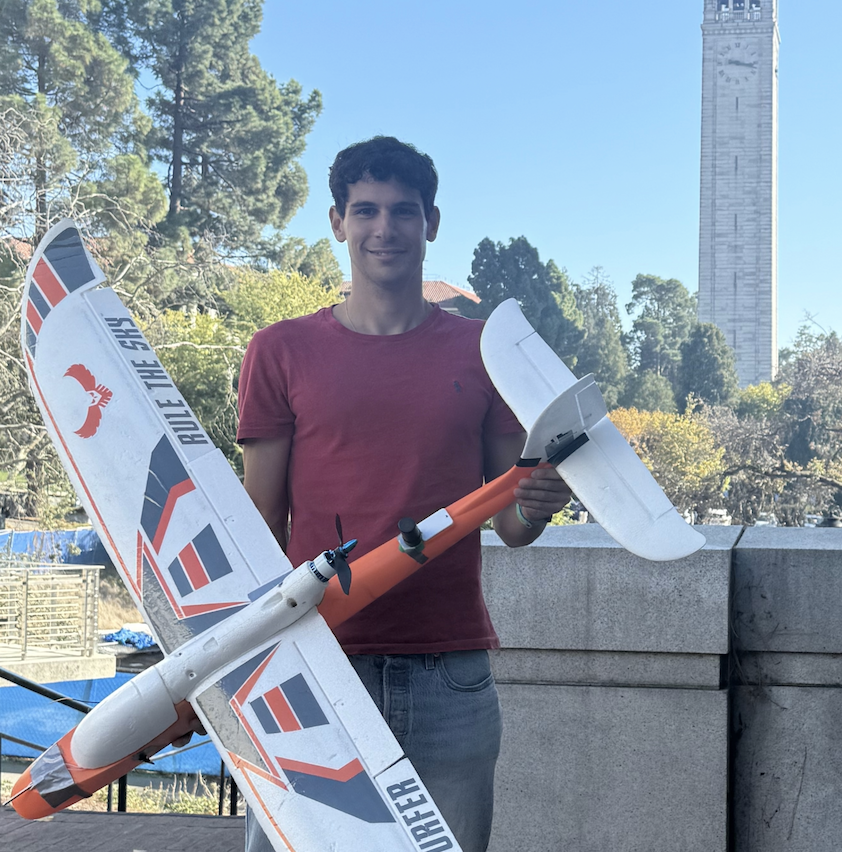
I am Luca Morando, an Italian robotics researcher currently working in the United States.
I am a Postdoctoral Associate at New York University and a Visiting Postdoctoral Scholar at U.C. Berkeley, both within the Agile Robotics and Perception Lab (ARPL), led by Prof. Giuseppe Loianno. My research focuses on aerial robotics autonomy, particularly long-range fixed-wing aircraft navigation and Human-Robot Interaction using Mixed Reality techniques.
I joined ARPL as a Visiting Ph.D. student in November 2021, spending two years there before earning my International Ph.D. in Robotics and Autonomous Systems from the University of Genoa under the supervision of Prof. Loianno and Prof. Antonio Sgorbissa.
Prior to my Ph.D., I obtained my M.Sc. in Robotics Engineering from the University of Genoa, including a year-long exchange at the Université de Technologie de Compiègne (UTC), where I completed my Master’s thesis at the Heudiasyc Lab under Prof. Pedro Garcia. I earned my B.Sc. in Biomedical Engineering from the University of Genoa, including a six-month internship at the Italian Institute of Technology.
My research has been validated through DARPA and Army Research Lab field trials, published in leading IEEE conferences, and has resulted in multiple journal articles and U.S. patents.
Ph.D. And Postdoc Research
Autonomous drones, both fixed-wing and multirotor, are becoming indispensable in critical missions such as search and rescue and disaster response. Unlike other robotic systems, drones can fly, cover long distances, and explore constrained outdoor and indoor environments where ground-based agents would fail. However, today’s systems still lack full autonomy and often require expert human pilot intervention. Additionally, despite their use in emergency and military applications, current drones lack proper mechanisms for intelligent interaction with non-expert operators, limiting their potential to evolve from simple tools into true human collaborators and companions.
My research focuses on building autonomous systems based on a simple premise:
Enabling safe and agile autonomy in unknown environments by adapting to dynamic conditions, achieving long-range and energy-harvesting capabilities, and providing enhanced human collaboration in complex mission scenarios.
Autonomous and Agile Planning and Control for Fixed Wing Aerial Vehicle


Despite their potential across domains such as environmental monitoring, disaster response, agriculture, and logistics, unmanned fixed-wing UAVs present significant challenges. While they excel in long-range endurance and cruise speed compared to multirotor vehicles, they exhibit complex, coupled, and highly nonlinear dynamics that are strongly influenced by aerodynamic effects across different flight regimes. These characteristics, compounded by external wind disturbances, pose severe challenges for trajectory planning and control.
My research addresses these challenges by designing flight architectures that leverage the aircraft’s complex dynamics while simplifying them for control objectives through Differential Flatness for geometric control. To maintain safe flight envelopes, we optimize continuous trajectories using Bernstein polynomials with dynamics-aware and wind-aware formulations that enable optimal cruising and energy-harvesting gliding conditions.
Additionally, we developed a fully dynamic and aerodynamically-aware NMPC framework for optimal trajectory tracking and disturbance rejection. This approach, tested across multiple platforms, provides resilient flight autonomy for long-range fixed-wing applications.
Human Robot-Drone Interaction for shared collaboration and exploration of indoor constrained environments through Mixed Reality

 Aerial robots have the potential to assist humans in complex and dangerous tasks without requiring expert pilots for teleoperation. My research aims to reduce users’ cognitive and physical workload by creating intuitive autonomy and interaction solutions that transform robots from machines into trusted collaborators capable of guiding humans through dangerous exploration scenarios.
I developed a bidirectional spatial awareness framework based on virtual-physical interaction through Mixed Reality (MR), creating an immersive environment where users and robots seamlessly share spatial perception and control commands with minimal mental load. Users can control robots by placing spatial waypoints or directly manipulating their virtual representation in a dynamically updated MR environment enhanced by real-time robot mapping.
The system provides bidirectional guidance: the robot runs an onboard autonomous pipeline that generates obstacle-aware, user-aware trajectories for safe navigation while providing haptic feedback if users attempt unsafe maneuvers. User studies demonstrate that this MR-based spatial awareness framework significantly improves interaction efficiency and reduces workload. The system is implemented as a web-based, cross-platform framework accessible from anywhere.
Efficient Navigation and Inspection of Large Photovoltaic Solar Plants using autonomous quadrotors

During my Ph.D., I collaborated with an Italian company specializing in drone-based PV plant inspections. Despite using waypoint-based planning, they sought to reduce inspection time while improving data quality. I addressed this challenge by developing an optimization-based visual servoing technique that autonomously detects and tracks PV arrays across different layouts and weather conditions. A machine learning algorithm fused thermal and RGB camera features to extract stable centerlines, which were tracked and predicted using Bayesian trajectory generation methods.
The project successfully reduced inspection time by 20% while collecting higher-quality data through precise array-following flight at lower altitudes, eliminating unnecessary traversal between rows. Following this success, my lab in Genoa secured one of the largest EU projects in this domain, establishing leadership in the field.
Together, my research in aerial robotics has equipped me with the skills and experience to develop complex autonomy systems across diverse applications: extending long-range capabilities for fixed-wing UAVs, creating human-robot collaboration frameworks for natural interaction and shared perception in exploration tasks, and delivering industrial solutions. These contributions advance the state of the art with robust, cutting-edge systems validated through multiple international publications and workshops.
Latest News
- September 2025: Journal Paper accepted for Publication on Autonomous Robots
- May 2025: Will present in person at ICRA 25. Conference paper and Workshops.
- February 2025: Paper Article accepted at ICUAS25 in Charlotte, US
- January 2025: Paper Article accepted at ICRA25 in Atlanta, US
- May 2024: Will present in person at ICRA 24. Conference paper and Workshops.
- January 2024: Paper Article nominated best paper finalist at ICRA24 in Japan
- January 2024: Paper Article accepted at ICRA24 in Japan
- April 2022: Published Journal paper on Autonomous Inspection.
- January 2022: Published Journal Paper on Complex Optimization for Energy allocation.
- November 2021: Joined ARPL as Visiting Ph.D. student in NYC.
- May 2020: Paper Article accepted at RO-MAN conference
- February 2020: Started JPDroni project for Autonomous PV inspections
- October 2019: Started Ph.D. position at UniGe


